
Notes and revisions – Walden Gone Wild


“Henry David Thoreau’s Magical Thinking”

A really nice article about Henry and his brother, John.
https://newrepublic.com/article/129218/henry-david-thoreaus-magical-thinking
“Henry David Thoreau’s Magical Thinking
“After his brother’s death, the writer began to reconsider the science behind life.”
By Branka Arsić
(c) Copyright 2016 New Republic. All rights reserved.
February 8, 2016
Photo: Miguel Vieira/Flickr
https://newrepublic.com/article/129218/henry-david-thoreaus-magical-thinking
Walden Gone Wild
Re-imagining the classic book Walden by Henry D. Thoreau as an irreverent, R-rated, stoner comedy.
Now available in the Kindle book store.

Now available in the Kindle book store.
Walden Gone Wild
an irreverent re-telling of the classic
book by Henry D. Thoreau
two-hour feature film script for TV or movies
eighth draft
by Shawn Paul Stewart
Kindle Direct Publishing
Dallas TX
Walden Gone Wild; a.k.a. Walden, A love Story; Two Hearts in Concord is published exclusively online by Amazon Kindle Direct Publishing. No part of this publication may be reproduced in whole or in part, or stored in a retrieval system, or transmitted in any form or by any means, electronic, mechanical, photocopying, recording, or otherwise, without written permission of the author. For information regarding permission, write to the author at shawnpaulstewart@yahoo.com.
PAu-2-422-692, PAu 2-228-949, PAu 1-605-213,
PAu X-XXX-XXX
Copyright (c) 1992, 1997, 1999 and 2016 by Shawn Paul Stewart (SPS), All Rights Reserved.
Printed in the U.S.A.
First printing via Amazon.com, February 2016
Based on a true story..
This is my primary research into what has come to be known as the “Transcendental triangle,” a love triangle involving Henry David Thoreau, Ellen Devereaux Sewall, a young minister’s daughter, and John Thoreau, Henry’s older brother.
Author Page on Amazon:
http://www.amazon.com/-/e/B00G6O0OP0
Website with references:
https://beforewalden.wordpress.com/
Cover art by the author.
FADE IN.
EXT. RIVER – MORNING
On a calm river, early morning, a boat glides by carrying two figures, one is poling and the other is steering.
ELLEN v.o.
In September, 1839, Henry David Thoreau and his older brother John, Jr., took a trip down the Concord-Merrimack rivers. It turned out to be something less than the quiet vacation they had in mind.
The water like a solid sheet of glass parts smoothly before the little dory’s prow. But the stillness belies something ominous.
Angry storm clouds knit their brows on the horizon. As he poles the dory through the shallows, Henry looks at them worriedly.
JOHN
You shouldn’t drink and pole.
HENRY
You could help, you know.
John BELCHES LOUDLY, crushes a beer can he was drinking from, and tosses it in the water. Several cans are floating behind the boat.
HENRY
Looks pretty bad. Let’s put in.
Henry keeps on poling, and the clouds keep on rolling in spitting lightning here and there.
JOHN
You know everything about boats.
An uneasy silence.
JOHN
And nothing about women.
HENRY
Leave off, will you?
JOHN
Push on, I say.
EXT. RIVER – NIGHT
An unholy downpour is falling from the sky. The storm has hit them head-on. The little dory rocks from side to side, creaking and groaning, fighting the mad current; Henry is poling, trying to find a bed to dig into, and John is alternately rowing and bailing out water. Their little lifeboat is on the verge of overturning and sinking, throwing these “sinners into the hands of an angry God,” as Jonathan Edwards might say.
Henry slaps one oar into an eyelet, leans into it hard, and tries to coax the bucking bronco of a boat towards shore. The oar snaps, one of only two on board, and Henry falls on top of John almost knocking him overboard.
JOHN
This is your fault!
HENRY
My fault?
The steering gone, they both tumble down into the keel and find themselves face to face, half under water, wet, cold, and shivering mad.
JOHN
I saw her first!
HENRY
What are you, in kindergarten?
JOHN
Who paid your way through college? Tuition, room, and board? You owe me!
HENRY
Not everything’s about money!
John stands up, balancing himself in the rocking boat, holding the last oar over high his head as if he’s going to smash it down on Henry’s face.
HENRY
Look out!
A big branch swings out of the darkness and rakes John off his feet, knocking him overboard into the crazy waters. John is a bobbling figure quickly left behind in the whirlpool of currents.
The river makes a ninety-degree turn at just that point, and the water slows down long enough for John to clamber up on shore using some vines and creepers, where he stands, flipping his hair back over his shoulder and looking around downstream for his brother. The boat is gone.
John takes off at a dead run through the forest, barreling down the bank as fast as he can after his brother and the renegade boat.
With a thousand tree branches and thickets and thorn bushes standing in his way, it becomes an obstacle course, but John rips through these without thinking.
He blasts through the woods like cannon fire. Emphasis here should be on blinding speed, knifing tree limbs, and the total disregard he has for his own safety while racing through this forest of razors.
Finally, he reaches a bend in a clearing where the river slows down somewhat, though the rain is still blurring everything in sight. It’s a mess along the banks, slippery, slimy, sucking pockets of mud. John stumbles toward the shore and shades his eyes.
JOHN
Henry! Henry!
He sees the boat caught up in some branches near the opposite shore… but where’s Henry?
In a small divot near the edge of the stream, Henry comes clawing his way up hand over hand through a mass of weeds and debris. He struggles to come onshore but even here the current is too swift and the slope too slippery. Mud dissolves beneath his feet as the soggy bank grows wider and wider. He flops down again into a tangled network of roots and vegetation and is stuck there permanently, too tired to fight.
John crawls out along the dead trunk of a tree in whose twisted arms and rotted roots his younger brother is now hopelessly tangled.
Henry reaches out a weak hand toward his older brother.
HENRY
Help me up. Dumbass.
John reaches out his own hand but stops short.
JOHN
Only if you help me.
Water is lapping over the younger man’s head. He can barely stay above water.
JOHN
A small wager: I ask her to marry me first. If she accepts, I win her hand. If not… you get the money and the girl.
Choking back water, Henry shakes his head “No” as hard as he can, adding to the froth and foam around his neck.
JOHN
She’ll never marry a debtor, and you’ll be in my ledger forever. This is your only chance to be free. Free of me. What’s the matter? I thought you said she loved you?
Henry gulps a breath of water, considering.
JOHN
Well, then?
At last now John extends his arm out and towards his younger brother. Their hands come together in the driving rain. A SLOW MOTION handshake. The deal is done.
ELLEN v.o.
But best to begin at the beginning.
FADE OUT.
FADE IN:
EXT. WOODS – DAY
Ellen flashes back briefly on her childhood. FLUTE MUSIC from the trees. She’s walking around looking up, trying to figure out where the music is coming from.
ELLEN v.o.
I remember the day I was married. I was ten years old. We were living in Concord, Massachusetts, where father was studying to be a minister. That’s where I first met David Henry Thoreau.
YOUNG HENRY, about 15 years old, shirtless and wearing homemade war paint, jumps out of a tree and scares YOUNG ELLEN SEWALL, then about 10.
YOUNG HENRY
Woo woo woo woo!
He’s pretending to be an Indian. She’s pretending to be impressed. He starts whistling on his handmade flute. Not bad for a beginner.
YOUNG HENRY
You know, the Indians believe that flutes cast spells over reluctant maidens.
He digs a hand in his trousers and comes up with a lovely, hand-woven ring made of flowers and yarn.
YOUNG HENRY
Here. With this ring, I thee wed. Ellen Sewall, will you marry me?
She’s not really paying attention.
YOUNG ELLEN
Yes. Kiss me now.
They do, laying their lips upon one another’s in tender adulation. Kid stuff… not too heavy.
YOUNG HENRY
Now you can’t move away. You’re my wife.
Little Ellen continues braiding flowers, bored.
YOUNG ELLEN
Yes.
EXT. THOREAU’S – DAY
Ellen is moving away. Her parent’s chaise wobbles away down the dirt streets of Concord. Young Henry waves at Ellen, who looks back at him through the sad rear window.
ELLEN v.o.
But I was ever a dutiful daughter, and of course grew up to be a model minister’s child.
INT. BEDROOM – DAY
Suburban Scituate, Massachusetts, near Boston, 1839.
We hear sounds of lovemaking. Or as it becomes clearer, the sounds of after-lovemaking. Kissing and smooching above all. A woman giggles. A man growls, slapping something we assume to be her bottom, pulling the woman closer. She giggles more, devouring his kisses.
Sitting on top of the man, the woman rises into frame. It’s Ellen, of course, now 17. The model minister’s daughter. Wrapped in nothing but a bed sheet. This can be PG- or R-rated depending on the director’s preference.
ELLEN
What if I touch this?
She reaches lower making her lover groan. It’s not important for us to recognize the boy just yet, JOSEPH. We will learn his name later.
From off screen, WE HEAR A CAR HORN. Not an eighteenth century buggy horn, but a modern day automobile horn. This is the first sign that we will be mixing timelines from here on out.
Ellen jumps, startled.
ELLEN
Oh, shit. It’s my parents.
She runs barefooted to the window and throws aside the curtain. Her POV: indeed, her parent’s chaise wobbles up the driveway.
ELLEN
Oh, shit. Oh, shit. You’ve got to get out.
JOSEPH
Where?
He looks out the window. They’re on the second floor, a long way down. The chaise is still wobbling up the driveway, almost too slowly to be believed.
She throws clothes at him. One of his shirts looks suspiciously like a priest’s collar. Even Unitarian ministers back then wore something similar, all black. She points to the window.
ELLEN
Just. Get. Out.
Shoving his legs into his trousers, Joseph looks at the window, unhappy.
EXT. STREET – DAY
Dirt streets. That’s the first thing the audience will notice. No sidewalks here.
Welcome to rural Concord, 1839.
John, 27, walks through down the street dotted with quaint colonial houses, thumbing through his iPhone.
ON-SCREEN: we see pictures of victorian porn. Women in their underwear covered down to their ankles. Not very sexy. But John seems psyched.
JOHN
Oh, baby.
He walks right past a man mowing his lawn in full Victorian clothing: great coat, vest, long pants. Phew! From our time period, it looks like he’s headed for church.
A horse clops kicking up dust and pulling a modern day pickup truck full of hay.
Kids roll by playing with a stick and hoop, high entertainment those days.
Mixed timelines.
EXT. HOUSE DAY
Cynthia Thoreau steps out the front door of the house wiping her hands with a wash rag. She looks down the street and sees her oldest son coming home for lunch.
CYNTHIA
John!
John is so busy fiddling with his phone that he walks right past the driveway where…
Two girls are washing their horse in the driveway, just like a modern car owner might do on the weekend. They have buckets, soap, even a garden hose, which does not exist at all in 1839. Oh, and, need we mention that the two girls are wearing very teeny bikinis?
They wave at John, flinging soap. Singsong:
GIRLS
Hi, John.
John walks by, unseeing. Then he steps back into frame, turns his phone sideways, and snaps a picture.
CYNTHIA
John!
John mounts the front stoop.
CYNTHIA
Where’s your brother?
JOHN
Who knows.
Waves to nowhere.
JOHN
Nova Zembla.*
*1839 saying for, “Timbuktu.” Far off somewhere .
John enters the house, leaving his mother stranded on the front porch, exasperated.
JOHN o.s.
Just call him.
Cynthia, somewhat old fashioned, fishes in her apron. We think she’s going to pull out a phone. Instead… she pulls out an old iron cowboy western dinner triangle calling bell. She rings it, loudly.
THE SOUND OF THE TRIANGLE REVERBERATES DOWN THE STREET.
EXT. WOODS – DAY
Various shots to show that: THE SOUND OF THE TRIANGLE FADES as it gets further and further away from the house.
EXT. TREE – DAY
Henry, now 22, has a very serious conversation with someone who’s sitting off screen.
HENRY
I don’t know. It seems like we’re just…. We’re going in different directions, you know? I dunno. I still care about you, but some times love’s not enough. You’re….
Reveal: off-screen, he’s talking to a woodchuck.
The woodchuck chatters as if it understands him and crawls into his lap. He strokes it, lovingly.
HENRY
Maybe we just… need a break.
Long pause.
HENRY
Maybe we should see other people.
The woodchuck turns on him with rabid teeth. And woodchucks have long teeth. It bites him right in the crotch.
HENRY
Ow! Sonofa-buckeyball!
Henry spins around with a woodchuck clamped to his crotch. Whatever it’s romantic inclinations, the damn thing doesn’t want to let go.
HENRY
Get off me! Goddammit! Sonofabitch!
THE SOUND OF THE DINNER BELL FADES IN. Even cross vast distances, Henry can still hear it, almost as if he has bionic hearing.
He spins around, knocking the woodchuck loose, which goes flying into a tree trunk. The woodchuck stands up on its hind legs, chattering angrily. Maybe even a SUB-CAPTION, translating:
WOODCHUCK
You bastard!
Henry takes off running toward the sound of the bell.
EXT. WOODS – DAY
Various quick shots show Henry hustling home for dinner:
Henry runs like a madman through the woods racing home for dinner. Like the Flash, he leaves a trail of fire in his footsteps. Literally. (Fire will be an important motif later.)
SUPERFAST POV – Henry blasts through the forest like a Speeder Bike from Return of the Jedi—under logs, around trees, around redwoods (incongruous, yes). He blows right past a small bush that flies up into the air. What looks very much like an Ewok emerges from the bush, exposed, shaking his fist at Henry.
EWOK
Eee chuu Taaa!
A lady Ewok emerges from the same bush, arranging her “clothes.” Yikes!
He jets across Walden Pond at supersonic speed, breaking the sound barrier, going so fast that he literally runs across the water, his feet barely touching the surface. (Simple wire work. Think of the scene where Clark Kent races the train in the 1970s Superman movie.)
EXT. HOUSE – DAY
Henry arrives, barely winded, but looking like hell.
HENRY
Hey, ma. What’s for dinner?
Cynthia shakes her head, following him inside.
EXT. CONCORD – DAY
Rural Concord, Massachusetts, 1839, downtown. Population: 1,784 people and probably double the number of cows and horses. This was a very small town, even then. Main Street on a busy week day. Carts, wagons, and coaches vie for their speck of the street, dirt or mud, in this tiny town center. It’s literally a one-stoplight town. Just for fun, let’s put an actual stoplight right on one of the busiest corners. It turns yellow just as a wagon hauling hay tries to run it.
DRIVER
Shit.
On cue, his horse actually does just that, takes a big dump in the middle of the road.
Stepping around the horse dung are two guys hauling a huge and log on their shoulders, HENRY and his older brother, JOHN. They are the target as we crane down to meet them. John and Henry are now 27 and 22 respectively. They’re talking absently, complaining about their load, and greeting people as they try to carry this huge 22-foot log on their shoulders. They’re doing a good Buster Keaton routine of the avoiding hitting things with the log.
JOHN
This is the most wood you’ve seen all year.
HENRY
Shut up.
JOHN
Seriously, dude, you need to get in the game. How did you go four years of college without getting laid?
HENRY
I was studying divinity.
JOHN
Oh, yeah, right. You mean they didn’t have cheerleaders in the ministry school? “Oh, god. Give it to me, god.”
HENRY
You’re an ass.
JOHN
Don’t be such a ninny. You’re gonna be some little house-husband on the prairie.
They wind their way through morning crowds, early day commuters. Several times, by turning and talking to one another, they nearly decapitate several townsfolk. Maybe Laurel and Hardy is more like it. People are cursing them, they ignore it.
Okay, to imagine this scene, you have to envision a comedian like young Will Ferrell playing Thoreau, mid-twenties, galways whiskers and all. (For neo-classical noobs, galways whiskers are those dorky, mid-eighteenth century beards that avoided the face and ran right around the chin, ear to ear. It kept the neck warm in the winter, some say.)
JOHN
Gotta pluck ‘em while they’re young. Look at her, how old you think she is?
A woman passes them by. She looks 67.
JOHN
She is 25, my man, ripe for the picking.
Henry makes a face.
What’s very obvious are the differences in the way that people are greeting the two brothers. Ridiculously good-looking John waves and smiles at everybody, and they wave and smile back, calling him “J.J.” or “Johnny Boy.” Friendly, familiar terms. A slap on the shoulder, high-fives.
By contrast, most people scowl and sneer at Henry. Avoiding his “Hellos.” Sneers, jeers, quick turnarounds. A woman with kids does a quick u-turn. He is definitely the least-liked brother… the town pariah.
The two brothers turn in to the sawmill which is also doubling as their father’s pencil factory.
INT. PENCIL FACTORY – DAY
They drop their heavy load onto a conveyor belt. The log rolls along.
JOHN
Ah. I love the smell of graphite in the morning. It smells like… lung cancer.
Henry pushes the log along and into the spinning jaws of a huge wood saw. The sound is ferocious as it chews through the log. It seems to be cutting away everything. Wood shavings, sawdust, pulp, and curlings fly everywhere.
At the other end of the assembly line, John slaps his father on the shoulder, who is waiting.
JOHN
How’s it going, pops?
JOHN, SR., grumbles. That pretty much becomes his shtick. He grumbles about everything, without saying anything.
The log continues through the assembly line and finally, right in front of both Johns, out pops one single pencil. That’s all. From the whole log, you get one single pencil. It’s like the old cartoon joke about the toothpick factory. From one entire log, you get a single toothpick.
John, Jr., picks up the pencil. On it is stamped JOHN THOREAU AND SON, emphasis on the singular, and SON.
JOHN
Seems like a waste.
John, Sr., grumbles. The other, the forgotten son, Henry, wanders over. Henry is completely plastered with sawdust and wood shavings. He looks like a wooden cigar store Indian. Or a brillo pad made of wood and tree resin. Ridiculous.
HENRY
What about my project?
John holds the pencil lower, in front of Henry.
JOHN
Gives whole new meaning to “pencil dick.”
…..
Read more in the Kindle book store.
Author Page on Amazon:
http://www.amazon.com/-/e/B00G6O0OP0
Walden, just sliiiiightly re-imagined
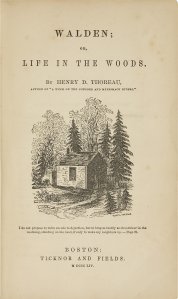
Near the end of March, 1845, I borrowed an axe and went down to the woods by Walden Pond, nearest to where I intended to build my house, and began to cut down some tall, arrowy white pines, still in their youth, for timber. I thought about chopping off my hands and saving future generations from having to read this tripe, but… let’s push on. It is difficult to begin without borrowing, but perhaps it is the most generous course thus to permit your fellow-men to have an interest in your enterprise. It’s also how I got to be known as the “cheapest bastard in town,” according to my brother. John, just like father, was an actuarial accountant. Or as I like to call him, a man in a monkey suit.
“Everywhere I go, it’s ‘Henry owes this, Henry owes that,'” said John. “Why don’t you to pay your bloody bills?”
“Because they haven’t invented credit cards yet,” I told him.
The owner of the axe, as he released his hold on it, said that it was the apple of his eye; but I returned it sharper than I received it. Odd, most people refer to kids as the apples of their eyes; it made me wonder what this guy had done with his axe. It was a pleasant hillside where I worked, covered with pine woods, through which I looked out on the pond, and a small open field in the woods where pines and hickories were springing up. Notice how often I refer to nature in the middle of pointless sentences that go nowhere. The ice in the pond was not yet dissolved, though there were some open spaces, and it was all dark-colored and saturated with water. Believe it or not, there are some businessmen who sell ice to idiots down south so that they can sip Long Island iced teas all summer. Why didn’t I think of that? There were some slight flurries of snow during the days that I worked there; but for the most part when I came out on to the railroad, on my way home, its yellow sand heap stretched away gleaming in the hazy atmosphere, and the rails shone in the spring sun, and I heard the lark and pewee and other birds already come to commence another year with us. Notice this long lovely image describing the railroad? I hate the railroad. I hate all technology, despite the fact that I’m using it here to find my way home. They were pleasant spring days, in which the winter of man’s discontent was thawing as well as the earth, and the life that had lain torpid began to stretch itself. “Winter of discontent,” that’s an allusion, in case you missed it. One day, when my axe had come off and I had cut a green hickory for a wedge, driving it with a stone, and had placed the whole to soak in a pond-hole in order to swell the wood, I saw a striped snake run into the water, and he lay on the bottom, apparently without inconvenience, as long as I stayed there, or more than a quarter of an hour; perhaps because he had not yet fairly come out of the torpid state. [Editor’s note: Henry, you broke the axe you borrowed, yet the whole point of this 84-word sentence is to tell readers that a stupid snake sat unmoving in the bottom of a pond-hole? Come on!] It appeared to me that for a like reason men remain in their present low and primitive condition; but if they should feel the influence of the spring of springs arousing them, they would of necessity rise to a higher and more ethereal life. Then again, all my neighbors are tilling their fields to feed their families while I am fucking around building a weekend cabin. What do I know? I had previously seen the snakes in frosty mornings in my path with portions of their bodies still numb and inflexible, waiting for the sun to thaw them. Others, like lawyers, never thawed. On the 1st of April it rained and melted the ice, and in the early part of the day, which was very foggy, I heard a stray goose groping about over the pond and cackling as if lost, or like the spirit of the fog. It was creepy as hell, so I took a stick and beat it over the head until it was dead.
Henry’s Journal, June 19, 1840

The other day I rowed in my boat a free, even lovely young lady, and, as I plied the oars, she sat in the stern, and there was nothing but she between me and the sky. So might all our lives be picturesque if they were free enough, but mean relations and prejudices intervene to shut out the sky, and we never see a man as simple and distinct as the man-weathercock on a steeple.
Henry’s Journal: Tuesday, June 4, 1839
I sit here this fourth of June, looking out on men and nature from this that I call my perspective window, through which all things are seen in their true relations. This is my upper empire, bounded by four walls, viz., three of boards yellow-washed, facing the north, west, and south, respectively, and the fourth of plaster, likewise yellow-washed, fronting the sunrise,–to say nothing of the purlieus and outlying provinces, unexplored as yet but by rats.
Photo credit:
http://www.icollector.com/Henry-David-Thoreau_i9933756
Twenty-Fifth Anniversary of the Wedding of the Rev. and Mrs. Joseph Osgood, Cohasset, Thursday, May 20, 1869
Twenty-Fifth Anniversary
of the
Wedding
of
Ellen Devereaux Sewall
Rev. And Mrs. Joseph Osgood
Cohasset
Thursday, May 20, 1869
Boston
Alfred Mudge & Son, Printers, 34 School Street.
1869
1869 July 5
Life of
Rev. Joseph Osgood
of Cohasset
Twenty-Fifth Anniversary
of the Wedding of Rev. and Mrs. Joseph Osgood
of Cohasset

Photo: First Parish Church on the Cohasset Commons in Cohasset, Mass., in 2011 (SJSPIX.COM/Steve Steinmetz).
The first Parish of Cohasset celebrated the 25th anniversary of the wedding of their pastor, the Rev. and his wife, by social entertainment in the Town Hall of Cohasset, on the evening of Thursday, May 20, 1869.
There was a very large gathering on the occasion, of members of the parish and other residents of Cohasset, and many friends from Scituate who formerly been under the pastoral care of the Rev. E.Q. Sewall. And others who had been connected with the parish were also present. As an interesting incident of the occasion it may be mentioned that there were six ladies present over 80 years of age, one of them Mrs. Lydia Bates, being in her 90th year. William B. Johnson, Esq., of Cohasset, presided.
At half past 8 o’clock, Mr. And Mrs. Osgood, accompanied by their nine children, and by Mr. Osgood’s mother, in her 88th year, and his brothers, the Rev. George Osgood and Dr. William Osgood and wife were escorted to the hall by a committee appointed for that purpose, having been conducted to seats on the platform, were presented to the audience by J.Q.A. Lothrop, Esq., chairman of the committee.
Remarks of Mr. Lothrop.
Mr. Chairman, Ladies and Gentlemen:
We have assembled together this evening, for the purpose of celebrating as event, the nature and circumstances of which you are, most of you, well acquainted with, having made suitable preparation therefore, in order that there might not be anything left undone that ought to have been done to make this a very social and pleasant gathering; and in carrying into effect a part of those arrangements, a committee was formed for the purpose of inviting the persons whose silver wedding we this evening celebrate, to be present with us. The committee have so far attended to their duty, that they have now present and upon the platform the guest of the evening. Ladies and Gentlemen, allow me the pleasure of presenting to you our pastor and his family, the Rev. and Mrs. Joseph Osgood and children.
Mr. Chairman, I also have the pleasure of presenting to you our pastor and his family, into whose charge the committee are happy to resign them, knowing as they do, that they will be cared for.
An opportunity was then afforded for personal greetings and congratulations of the guest of the evening. After half an hour or more had been devoted to this purpose, the audience was called to order by the chairman, and Rev. W.H. Fish, of South Scituate, offered the following.
Prayer.
Or Father, who art in heaven, we rejoice that Thou art also on earth, and always with us to bless us; to bless us altogether beyond our deserts, but according to all of our needs. In our hearts may we recognize Thee as the giver of every good and perfect gift, and love Thee because Thou hast first loved and art always loving us, and manifesting Thy love to us in so many various ways, supplying all our temporal and all our spiritual wants. In the midst of these festivities would we come to Thee, O our Father, thanking Thee that Thou hast brought us to this hour, with all these pleasant surroundings, and that we are here with so much of health, and so much cheerfulness and joy. May all our hearts go out in thanksgiving to Thee. And in behalf, oh Father, of the pastor of the church which has generously devised and provided for this festive occasion, would we thank Thee, and behalf also of his beloved companion, that have been so happily united for these twenty-five years. Their hearts glow in thankfulness to Thee that no words of theirs or ours could possibly express/ We thank Thee that all their children are privileged to be here on this occasion. We thank Thee that they are so blessed, not only in each other, but in these their offering. We pray Thou wilt still smile upon them as in times past, and we know that now, on this important occasion, they will in all their hearts consecrate themselves to Thee and manifest their gratitude by endeavoring to do more cheerfully and perfectly Thy will.
Father, we thank Thee that the aged mother of our brother is also permitted to be here and to rejoice with her children and grandchildren on this occasion. In behalf of those connected with them by ties of kindred and tender love, would we thank Thee. And behalf of this perish, that this union between them and their beloved pastor has also been so happy for so long a time. We feel that both have been fortunate-pastor and people-and we thank Thee that he has enabled to be here with his family tonight, rejoicing that his labors are so full appreciated, and that he has gathered up so much of the respect and deep and true affection of his people. O Father, may this union still continue and more and more may he see the fruits of his labor, Thy work prospering in his hands.
And now, O Father, we would in our hearts, for all those blessings which we enjoy, and for all the good things for which we hope, consecrate ourselves to Thy service, thus expressing the gratitude which our words cannot express. We thank Thee that old and young and middle-aged, that all classes, are this evening to express their joy and mingle together in social communion, and we pray that this may have a tendency to bind our ministers and their societies still closed together. May we feel that we have a common faith and a common interest. And, O Father, when all these associations shall be dissolved, when this earthly union shall cease, and when we shall all be summoned hence, oh may it be to go up higher, to pass into Thy more immediate presence in that blessed world “where they are neither married, nor give in marriage, but are as the angels of God in Heaven, ” but where their hearts still glow with love and are warmed with true devotion to Thee.. O Father, help so to live that we shall have more and more faith in Thee, more and more faith in true religion, more and more faith in the immortal life, and at last lead us all to Thee, where tears are wiped from all eyes, and Thou, the God of love, art all in all. And unto Thee, our Heavenly Father, in the spirit of Jesus, Thy beloved Son, shall be grateful homage of our hearts evermore. Amen.
The following lines, written for the occasion by Miss S.P. Oakes, were them sung by the choir to the tune of the Italian Hymn:
Blue were the skies of May
That arched o’er that bright day
When we were wed.
The sungleams kissed hall,
With music flowed the reel,
Our hearts in prayer were still,
True words were said.In your youth our souls we bound,
Each in the other found
Its life complete,
How fair the earth, was then,
With bloom in wood and glen,–
Such bliss ne’er comes again,
It were to sweet.Since then the lights and shade
Life’s woof have checkered made,
Yet have left us blest;
For, in the fields of God,
We’ve turned the yielding sod,
And ever cheerful trod
Toward our rest.Just five and twenty times
We’ve heard our marriage chimes,
As years flow by;
And five and twenty days
Are marked along life’s ways,
On which we pause to gaze,
Love, you and I.Some graves each mortal makes,
Oft times a harpstring breaks,
And discord jars;
But from the loss comes gain,
Rare bliss grows out of pain,
The strains run true again,
Beyond the stars.This silver wedding-day,
Binds with a glittering joy,
The past and now;
And youth and middle-age
Meet on the present stage,
And write on one white page,
The marriage vow.
Presentation Speech By The Chairman
My friends: what are we here for tonight? What means this large assemblage in this building? I will answer you. On the 20th day of May, 1844, our minister, the Rev. Joseph Osgood, was united in marriage with Miss Ellen Devereaux Sewall, of Scituate. Twenty-five years have passed away and we are assembled here to-night to meet them and to greet them at their “silver wedding”. We have come to this public building from every portion of our town. Some of us have come from neighboring towns and the city of Boston. We are here to bestow upon our beloved pester and his faithful and devoted wife evidence of our friendship, of our respect and personal esteem.
My dear friends (addressing Mr. And Mrs. Osgood), before you and around you be pleased to see the upturned and smiling faces of your friends and members of your perish. They have selected me to speak for them, to tell you with glad hearts they welcome this even, this “silver wedding”. You will see those of us whose gray hair indicate that the parental tree has grown to a good old age. You will see those of us who welcomed you as a young couple just commencing life, and who have stood by you and remained your friends ever since. You will see those of us among the young-and many there are who have come upon the stage of life during your ministry-who are now prepared to take the place of those whose destiny it is to be cut down by the scythe of death.
We are, sir, very happy to wee with you your aged and honored mother. She has come a long journey to be present on this very pleasant and interesting occasion and bestow her blessings on the heads of her children and grandchildren. You, sir, are more favored than most men at your time of life, to be able to say, “My mother.”
Permit me, sir, to borrow a part of a paragraph from your quarter-of-a-century sermon, which I think will not be out of place on this occasion.
“I have never suffered myself to cherish any feeling of enmity or ill will towards any one in the society; and if any one has felt offended with me, or unkindly toward me, I have never permitted myself to reciprocate the feeling.”
Those are your golden words and this your silver wedding! Behold, sir, your friends! Know by this great out-pouring of humanity that we love and appreciate your good works in the pulpit, and out of the pulpit.
And now, my dear friends, I come to another portion of the duty with which I am charged, and it is to me the most interesting. Your friends in and out of the perish, in and out of the town, wishing to commemorate this most happy event in your lives have bade me present you with these articles of silver ware, as a token of their affection and esteem.
I also take great pleasure in presenting you with this package of money, in amount of $350, $50 of which sum comes from your friends in Scituate.
Having acquitted myself of this pleasing duty, I command you, my friend Joseph, to Him whose faithful servant and minister you are, and to that watchful care over you and the members of your family which he accords to all who love him.
“Twenty-five years of married life,
With many cares, without strife,
Thrice happy couple they must be,
Whom you and all come here to see.” [applause].
Response of Mr. Osgood.
Mr. Chairman and friends from my own parish in Cohasset, friends from Scituate, those of you who, have gone from homes here, have returned to be with us this evening, members of other societies who are present, and friends from abroad: I would express to you profound gratitude, the deep pleasure that I feel on this occasion, and that I fully reciprocate all your kindness, and all your expressions of regard. I should like to say a few words to you, and in doing so I shall not try to speak rhetorically or to use any figures of speech, but shall endeavor to speak the simple truth as I feel it. I know this evening while you are celebrating my “silver wedding,” your thoughts are not confined to that, but you are also thinking of and celebrating a kind of wedding by which I became united with more than twenty-five years ago, and you cannot this evening separate in your thoughts those two occasions. The few words that I hope to say must therefore have a double reference.
All the circumstances of the day, twenty-five years ago, when the event took place, the twenty-fifth anniversary of which you celebrate this evening, are fresh and distinct in my mind, and the thoughts and feelings that were then in my heart are fresh there still. I remember my journey into New Hampshire; I remember the rich green of the leaves in the rain; I remember all the hopes and anticipations that then filled my heart, and all the fullness of joy and satisfaction. My own private joy, my own private satisfaction, and all the circumstances of that event were associated with you; and thoughts of you, of those in my parish to whom I was ministering, were continually coming to my mind and mingling with the thoughts of that occasion. Then life looked beautiful and full of promise to me, yet it was full also of uncertainty and doubt. While I anticipated many blessings in the future, I knew from my experience with you, from having been with you in all of the conditions and experiences of your lives, how many disappointments, how many trials I must expect to encounter. There is one line in that hymn that was sung this evening that is not quite true. It speaks of the thrill of joy and hope never be repeated:
“Such bliss ne’er comes again.”
That is a mistake, for as pleasant, as full of hope, of joy, and of anticipation, was not equal to the experience of this day and this evening. I say these words, not in response of the kind of words that have been uttered, and the cordial greetings which I have had from so many friends, but I say them from the calm reflections of my mind as I have meditated upon the circumstances of my life. We call this a “silver wedding,” and the silver on my head might itself justify that designation, but we have not progressed far in Christian life unless we can know and feel that as we advance towards the termination of life the peace and joy and hope and promise and beauty of life, may and should increase. And tonight I look forward to the future with more hope, and more of anticipation, with more of confidence, with more of peace, than I did twenty-five years ago on that quiet day in May, when that most important event of my life took place. And why should I not? All my experience, although it has been associated with sorrow and trail and hardship, has ever been bringing blessings, new hopes, new solaces, and new joys. But I will not dwell longer on this point.
I wish to say a few words to you of my own perish in Cohasset in regard to my relation to you. The question has often been asked me by my brother clergymen, “How can you stay in one place so long? How can you find anything to say? I should think you would be tired out and desirous of changing your position.” Well, there have been times when I have felt heavily the burdens of the Christian ministry. There have been many hours when it would have been a relief to me to have been freed from the charge of this society, and there have been many hours when I have felt discouraged, when difficulty in meeting the expenses of my family, difficulty in satisfying myself in the work of the ministry, and the many discouragements and trails that belong to a minister’s lot, would have made me very willing to resign my charge. Once I did ask you to relieve me from the charge, and I supposed that the release would be final; but somehow or other it was like going from one’s own home. I found that you and your fathers did not feel did not feel like having the connection severed, and the more I thought about you the more I felt that here is my home; and , notwithstanding all these trails and disappointments, notwithstanding all these feelings of dissatisfaction with myself, notwithstanding all the weariness and heaviness of the work itself, there have been compensations which have continually cheered and encouraged me.
Every house in the perish has always been wide open to me, and more than that, I believe every house in the town has been open to me, not only in our own perish but in the other perishes. And I could never have crossed the threshold of the house of a foreigner-Portuguese or Irish-without feeling that I was welcomed. The longer I have stayed with you, the more closely have I felt myself connected to you. When your dear ones have been taken away, it has seemed to me oftentimes almost as if members of my own family were being carried to their last home. When you have been united in marriage, and in the gladness and hope and joy of your young love have pledged your hearts to each other, you have seemed to me like brothers and sisters or children of my own; my heart has sympathized with you, and you know not how very near you have seemed to me. And when you have brought your little ones to the alter to consecrate them to God and to Christ and to the spiritual life, I have always felt a deep and pure joy in consecrating them to all purity and truth and goodness and holiness. And when I stood by the bedsides of those whose lives were passing away, my own faith and trust, my own hope and my own confidence in God and in spiritual things have been strengthened more and more.
And when ever I have heard or known of anything wrong in word or deed amongst you-and sometimes my heart has been pained in that way-it has seemed like a sin or unworthiness in my own family, and has always given me pain. On the other hand, when I visited the houses of the poor, the suffering and the sick, when I have meet those who have had a struggle in life, and they have told me of some of you whose names I could now mention, who in secrecy have not only sympathized with them, but have helped them of your abundance, and have continually doing for them deeds known only to themselves and to God, I have felt proud and glad in you, and have rejoiced in the thought that there was so much pure love and holy charity in the people of my charge.
Thus we have labored together. I have always felt almost as deep an interest in your prosperity as in the prosperity of my own children, and have shared in your sorrow when God had sent affliction upon you.
As I stand here to-night my thoughts are not permitted to rest on you alone. I cannot think of those who greeted us when, a new married couple, we came to make our home with you. I cannot but think of those who have been associated with us in the church, in Sunday school, in our relations as neighbors and friends who have passed away, and whose spirits, I feel, if they knew anything of what is going on earth, are looking down in sympathy and approval from the spirit world.
If I allowed myself to go on in this strain farther, I should weary your patience, but permit me to say to you-the members of my parish, those associated with me in the Christian work in this town-that while we feel that the shadows are growing longer, while we feel that every day and every year is bringing us nearer and nearer to the close of our connection and to the end of our earthly career, yet if we live truly and nobly, doing each the duties that belong to the day, instead of its being downward, it will be an upward course, continually ascending into higher and higher regions of faith, of hope, of joy, and of peace.
I wish to say a few words about the cause of this long connection which has subsisted between this perish and myself. Why is it, while in so many parishes the connection has been so frequently broken and the ministries have been so short; why is it that in this particular instance our connection has been so long continued? I believe that it has been owing to two or three causes which it would not be improper for me to refer to. One of them-and it has been essential to the continuance of the connection-has has been your patience, your forbearance, your consideration for me. I have, time and again, felt so dissatisfied with my own work and with my own ministry, that I was ready to lay down the burden and relieve you from my presence; but your forbearance, your consideration, your sympathy, your willingness to over look all my mistakes and blunders, and to take the will for the deed when I have said and done things which I should not perhaps have deliberately said and done, have tended very much to preserve this connection. And then, on the other hand, I have tried simply to do my duty to you. I have felt my home to be with you, and this to be more of a family than an ecclesiastical relation. This, I think, has tended very much to preserve and continue our union.
And then, permit me to say, that the event, the twenty-fifth anniversary of which we celebrate to-night, has not been without its effect; for the patience, the industry, the willingness to endure privations and hardships of her who was united in marriage with me twenty-five years ago, have been essential to enable me to continue in this relation, and I feel that it would have been impossible for my connection with the perish to have continued without the aid, sympathy, patience, forbearance and cooperation of her whom you seek equally with me to honor this evening.
Permit me now to say one word to the large number who are present from Scituate, for I feel that I should be doing injustice to my own feelings and to this occasion, for next to my own perish, that perish has been nearest to my heart and most intimately associated with my ministerial life. Those of you, brothers and sisters, who comes here to honor us this evening from that perish, come with vivid remembrances of him who was seventeen years your pastor. I know how deeply, truly and sincerely that perish loved Mr. Sewall and his wife. But as deeply and truly as you and your fathers and your mothers loved him and his wife, your love and interest they have felt for you. Among all the ministers with whom I have been acquainted, and in all the parochial relations of which I have had knowledge, I never knew a minister and his wife whose hearts were more deeply interested in their people, or who felt more tenderly towards them, than did Mr. And Mrs. Sewall; and if their spirits can now look down from the heavenly world, I know they will look down with deep sympathy and approval on this occasion.
Before I close, let me say a word to those others who are present, members of other societies, and those who have come here to exchange congratulations with us from abroad. I feel the greatest gratitude to you all. I appreciate the interest you manifest in this occasion. And I wish to say that my relations with the members of the other churches of this town, with those who have never been associated with us, have always been of the most pleasant cheerful and neighborly character.
And now permit me to express in behalf of my wife and myself the deep gratitude we feel to you all on this occasion, our high appreciation of your kindness and sympathy, our thanks for these beautiful presents which will be valued, not only for their intrinsic worth, but as mementoes of your interest and affection; and for the pecuniary gift, which will not only be prized as a token of your love, but will assist us in meeting the burdens which devolve upon us in the providing for our temporal wants. It is not likely that we shall ever meet together again on such an occasion as this. It may be that there will be a “golden wedding” for us, but with regard to that we ought not to be anxious; weather we shall be permitted to celebrate such an event here on earth or weather we be called up higher into the new and better life of the spiritual world, where the love and goodness of God, and the love of all true sympathetic hearts are as active and as continuous as here on earth, it matters not. We shall all, I trust be ever the objects of the good Father’s care and love, we shall all be led in the right way, and God will, day by day and year by year, give to each one of us what he sees to be best for us.
The following original hymn, by the Rev. George Osgood, was sung by the choir:
Silver Wedding song.
The may flowers bloom in the field and wood,
The birds sing on the tree,
And still they break o’er rocks and sand,
The waters of the sea;
Yet a many year has come and gone,
Since dawned your bridal day,
And many a dark and golden tress
Has changed to silver gray.With hope and gladness children came
The hours of home to cheer,
And still they go from strength to strength,
With each advancing year;
The first and last, those sisters sweet,
Who side by side were laid,
In heavenly beauty now unfold,
Where flowers can never fade.Though some who blessed your bridal day
Are here no longer seen,
Their spirits still to us may turn,
With love and joy serene;
Then shall your hopes be fair and bright,
As when the marriage ring
Forever linked you lives in one,
The happiest morn of spring.
A song by Miss Percival followed.
The chairman then called upon the Rev. H.L. Cargill of Scituate.
Remarks of Rev. H.L.Cargill
Mr. And Mrs. Osgood; I had begged your committee not to ask me to speak; but when you spoke of my perish, I thought I ought to tell you how mush my people love and respect you.
When I read the invitation to your wedding in my church, Sunday, men and women who could not be here to-night, came to me and said, Shake hands with Mr. Osgood for me, and tell Mrs. Osgood how pleasantly we still remember her.” And some said, “The words of her father spoken to us in our childhood, have been guides to us all our lives.
Believe me, if we could shut our natural eyes and open our spiritual eyes, we should see, falling in holly showers about us, the blessings of those Scituate homes.
You have said that it is not probable you will live to have your golden wedding. I can only add that I hope you may, reaping the harvest of another twenty-five years of holy work, when those who are children to-night shall have grown, under your spiritual directions, to be the strong citizen and the good mother.
Let us remember there is one marriage more holly than silver or golden: the reunion of two souls in high heaven, where as the Christ was in Cana of Galilee shall he be again, and God bestow the bridal gifts.
The chairman next called upon the Rev. Mr. Fish of South Scituate.
Remarks of the Rev. Mr. W.H. Fish.
This is no time, Mr. Chairman and friends, for further address of any considerable length, and I do not purpose to detain you more than two or three minutes. I am certainly very glad to be here-to be here under such pleasant auspices; and I look upon the family group, upon Mr. And Mrs. Osgood, with these children of theirs, and his aged mother, I can understand very easily why he should say that not that first marriage, but this anniversary of it, the happiest period of his life. I think he may well rejoice that “his lines have fallen to him in such pleasant places.” We all feel that he and his family must be very happy on this occasion, and that their happiness is too deep for any words to express. And certainly this relation that has also existed so long between him and the perish is a most happy one. Fortunate is he in having had such a ministry of twenty-five years, of which he can speak as he has spoken. As he was speaking I was reminded of a remark which Dr. Channing makes in one of his letters, and he had found his life a constantly improving one. Some say, looking back upon that past, and to the early religious experiences particularly:–
“What peaceful hours I once enjoyed,
How sweet there memory still!
But they have left an aching void,
The world can never fill.”
Of course, there is a pleasure worth remembering, about first expressions and early associations, but very different from the poet’s seems to be the feeling of our brother, who has just spoken to us of his life as the light that shineth more and more brightly unto the perfect day. He has now more faith and more hope, and his prospects seem better to him than at the commencement of his ministry. And so, friends, may we all use life, that it may be thus with us, to the end-that not childhood, nor youth, shall be the happiest period, but old age should we live to be old; and this will be sure to come to pass, if we only rightly use the faculties God has given us, and all our opportunities and privileges. But if we so live as to get the real good out of life that we can, by getting the greatest amount of usefulness into it, we not grow old-in spirit, at least. Many grow old and become weary of life, because they have not rightly used their faculties, and consecrated them to noble ends-really “rusting out.” Let none of us, my friends, rust out.
I am glad of these occasions which bring together ministers and laymen from our different parishes. I want to see all these ministers and parishes interested in each other and in each other’s work, feeling that they have a common faith in one God our Father, and in Jesus Christ; a common interest on earth, and a common home in heaven. I also want to see them rejoicing in each other’s prosperity, and helping each other and our common cause to the extent of our ability. When they all come into this true Christian relation with each other, then there will be such a moral and spiritual power in the community as they never have been before. Virtue will go out of them for the healing of the people,; and others, seeing their good works, will be lead to glorify the father of spirits.
It is pleasant for us to be here, and I would like to say more, but must not. We all feel alike, and if I were to speak particularly of this occasion, I should only unnecessarily express the emotions of your hearts. We all feel alike this morning. We looked into the heavens when we first arose-I am sure many did-and feared that this would be an unfavorable evening, and that there would be few here. We feared this, but the clouds passed away and we have come here in goodly numbers, and are now enjoying the occasion, and I leave you, my friends, to enjoy yourselves more socially. We need time for a social interchange of our thoughts and feelings. Only let me add that this scene here tonight, this common joy that ours, if we only rightly use this life, and all the powers which the good God has given us, is as nothing compared with what is to come, when we shall pass on to where there scenes “surpassing fable.” What that life shall be, as what this is, depends greatly upon ourselves. So, I pray you, friends, come, not only to feast in honor of your beloved pastor, but go from Sunday to Sunday and listen to the words of truth that he shall dispense to you, and have a feast there-a spiritual feast-and allow him to gather up all your affections to the dear God and Father, linking them to him by filial ties, thus making you feel that there is indeed another world, a heavenly state, because you are in union with it. Soon these aged ones will pass away, and I look around with joy and hope of these youth that they will leave behind. I they will come forward in faith and zeal to fill the places of their parents, and carry on to perfection the cause for which they have done so much. May you, friends, you who are young, under the ministry of your beloved pastor, consecrate yourselves to religion and goodness thus early in life. Then you will have many another happy time like this here on earth; your joy will be all the greater by your consecrating yourselves to your Heavenly Father’s service, and when you pass away in your turn, you will simply go up higher, and secure those joys of which here you can have only a foretaste. And so in that heavenly world may we rejoice with those whom we shall meet there, and send sweet influences upon us. It is well for us to feel that heaven and earth are intimately connected, and that we belong not here alone, but there; and as certainly as we feel sure God’s love and never walk in darkness, but in the true light and find that life with us is progressing in happiness, because it is progressing in true wisdom.
After a song by Mrs. Tower, the audience united in singing,
The Silver Wedding Day.
By Mr. Angier.
Tune-“Auld Lang Syne.”
We come, dear friends, with happy hearts,
Love’s summons to obey;
Nor would we fail with joy to hail
This silver wedding day!
Your silver wedding day, dear friends,
Your silver wedding day;
Nor would we fail with joy to hail
Your silver wedding day!For many years, ‘mid hopes and fears,
You’ve tred life’s pilgrim way;
Then sure ’tis meet that thus we greet
This silver wedding day!
Your silver wedding day, dear friends,
Your silver wedding day;
Then sure ’tis meet that thus we great
Your silver wedding day!What though youth’s earliest dreams are fled?
Though gone life’s spring-time gray;
We may not fail with smiles to hail
This silver wedding day!
Your silver wedding day, dear friends,
Your silver wedding day;
We may not fail with smiles to hail
Your silver wedding day!May He whose smile can care beguile,
And winter turn to May,
Bid this dear pair His blessings share,
Their silver wedding day!
Your silver wedding, day dear friends,
Your silver wedding day;
May this dear pair God’s blessing share
On their wedding day!
Prayer having been offered by the Rev. George Osgood, the company partook of a bountiful collection which had been provided by the ladies of the parish, and the remainder of the evening was devoted to social intercourse, the proceedings terminating at the late hour with the singing of Old Hundred.
The Diary of Thoreau’s “Gentle Boy”
Reprinted with permission:
Hoagland, Clayton. “The Diary of Thoreau’s ‘Gentle Boy’.” The New England Quarterly, Vol. 28, No. 4 (Dec., 1955), pp. 473-489. JSTOR.org. Web. 09 March 2015.
The Diary of Thoreau’s “Gentle Boy”
by Clayton Hoagland
ENTERING in his Journal on August 1, 1839, Ralph Waldo Emerson wrote:
Last night came to me a beautiful poem from Henry Thoreau, “Sympathy.” The purest strain, and the loftiest, I think, that has yet pealed from this unpoetic American forest. I hear his verses with as much triumph as I point to my Guido when they praise half-poets and half-painters.
Emerson was then thirty-five, Thoreau just turned twenty-two, and two years out of Harvard. While Emerson was Concord’s celebrity, Henry was but a promising essayist. Walden was still fifteen years in the future.
The poem by Thoreau which Emerson read on that August evening had been written five weeks earlier, and the subject was a boy of eleven, Edmund Quincy Sewall. With his mother, Edmund had been visiting the Thoreau household. The poem opens:
Lately, alas, I knew a gentle boy,
Whose features all were cast in Virtue’s mould,
As one she had designed for Beauty’s toy,
But after manned him for her own strong-hold.
On every side he open was as day,
That you might see no lack of strength within,
For walls and ports do only serve alway
For a pretence to feebleness and sin.
The complete poem of thirteen stanzas Thoreau wrote into his own Journal on June 24, 1839. Only two days before, Edmund Sewall and his mother had bid goodbye to the Thoreaus after a week’s visit to Mrs. Sewall’s mother and sister, Prudence Ward, boarders in the Thoreau home. The following year, in March, young Edmund would come back to Concord as a pupil in Henry Thoreau’s school, and a member of the household.
On that Saturday, June 22, on which Edmund and his mother went home to Scituate, Massachusetts, after the visit, Thoreau entered these lines in his Journal:
I have within the last few days come into contact with a pure, uncompromising spirit, that is somewhere wandering in the atmosphere, but settles not positively anywhere. Some persons carry about them the air and conviction of virtue, though they themselves are unconscious of it, and are even backward to appreciate it in others. Such it is impossible not to love; still is their loveliness, as it were, independent of them, so that you seem not to lose it when they are absent, for when they are near it is like an invisible presence which attends you….
Here, obviously, and in view of the date of the entry, is the prose seed of the poem Emerson read and praised in August.
Edmund Sewall was the son of Edmund Quincy Sewall, Unitarian pastor of Scituate. The boy was born February 29, 1828, in Newburyport. His mother, Caroline, had been a Ward. His grandmother and his aunt Prudence had lived in Concord since 1833. As paying guests for years in the Thoreau household they were, of course, intimate friends of Henry Thoreau, and Prudence Ward, as Canby says, “was constantly writing to the Sewalls of Mr. John’s or Mr. Henry’s affairs as if the Thoreaus had been relatives.”
That week’s visit of Edmund was not only a notable episode in the life of this unusual boy, it was also of significance in the career of Henry Thoreau. A month after the visit of Edmund, his sister Ellen made a similar visit to her grandmother and aunt, staying with the Thoreaus during part of that July, 1839, and thereby inspiring the double romance in which each of the Thoreau brothers in turn proposed to her. That story has already been told.[1]
Edmund’s journals, covering nearly three years of his boyhood, and letters he wrote home from Concord, have recently come to light. A fascinating chapter in the lives of the Thoreau family is now for the first time revealed. In it we find the first authentic description of the school conducted by Henry and John Thoreau, and several intimate glimpses of life in their household which are not available elsewhere.
Edmund Sewall was a cousin of the Alcotts, and it was Louisa May Alcott’s father who first persuaded the boy to keep a journal, when he was but nine years old. By the time Edmund’s mother brought him to Concord he was skilled in writing in his diary such anecdotes of daily life as a boy of his age thought memorable.
He covered that week’s visit to the Thoreaus in a few paragraphs in a thirty-two-page “writing book.” It was on a Monday afternoon, June 17, 1839, that he and his mother traveled sixteen miles by stage from Boston, arriving just in time to enjoy the supper prepared by Henry Thoreau’s mother.
In the week that followed the Sewall boy found his deepest pleasure in excursions along the Concord River “in a boat which Messrs. John & Henry T. made themselves” [he wrote]. “The boat was not quite large enough to hold us all viz. Mother, Aunt, Messrs. J. & H.T., Frank (one of the boys who board there) & myself, so Messrs J & H walked alternately on the bank generally taking Frank with them. We had not the benefit of a good wind so that we used the sail but little.
“After sailing a considerable time Mother, Aunt and Mr. H Thoreau went home leaving us in the boat. We then went up the North branch of the river. On our way we landed on a large rock where Mr. Thoreau said parties were in the habit of coming to make chowder & eat it….
“We went into the boat and proceeded till we found a boat which Mr T. knew belonged to a Mr Haynes, moored. We heard the report of a gun in the woods and went to see him shoot. He is the best marksman in Concord. He was firing with a rifle at a mark a little larger than a dollar at a distance of 55 yards or 10 rods. He never failed to hit it in some part while I was there. He had two dogs with him….
“Mr H. Thoreau also went with me e the boys to ‘Dover Cliffs.’ The upper part of it is a rock, the lower is covered with bushes. I & one of the boys when we were at the bottom climbed up to a fissure in the rock. I rolled down a stone which made the boys below jump out of the way. When they went away to school Mr T & I staid behind and visited Walden Pond which is 90 feet deep on an average. The water is so clear that you can see the bottom where it is 8 or 10 feet deep.
“We found a boat there and sailed across to a bar which runs out into the pond which is a good place to fish. There are only 2 places in the whole circumference of the pond where it is shallow near the shore, and in most other parts 4 steps into the pond would make the water over my head.”
It was a day or so later that young Sewall and his mother went home to Scituate, and Henry Thoreau wrote into his journal that poem which later became his contribution to the first issue of Margaret Fuller’s Dial.
Most likely the idea of Edmund’s returning as a pupil the following spring was in his mother’s mind during this week in Concord. The visit served to make the boy familiar with the Thoreau household, and the family in turn were attracted by his candor, charm, and intelligence. He was a most perceptive boy, and during his school days there under the guidance of John and Henry he lived a rural boy’s life, in sharp contrast to his experiences in and around Boston.
His journal not only opens windows upon a boy’s world, it gives glimpses of some notable personalities and public issues of that time. On two occasions this boy heard William Lloyd Garrison speak for abolition. He was only nine years old when he first recorded, in September, 1837, a meeting in Scituate:
“In the afternoon at 7 o’clock I went to an Antislavery lecture by Mr. Codding who related several anecdotes. One of these was this. A man who was intoxicated was approaching a tree, staggered himself, and looking at the tree, said ‘how that tree staggers!’ Another was of a boy who had been almost drowned, who said ‘I’ll never go into the water again till I have learned to swim.’ … After Mr. C. had done Mr. Garrison made some remarks. The meeting was done about half past 9. I sat in the gallery. After the meeting there was a contribution. I put nine pence into the hat….”
Into his journal on April 8, 1840, Edmund entered a toobrief account of a talk he heard in Concord during the period when he was attending the Thoreau school:
Went to a lecture from Mr. Emerson in the evening. It was on Literature. I was not at all interested. He is a tall man with piercing blue eyes. One of his ideas was that every one should think for themselves. I forgot to say that the master invited Albert Bason and Joseph Keyes and me….
As the master, Henry Thoreau believed his pupils would profit from the opportunity to hear a great man lecture on self-reliance. On that same April evening Henry himself wrote into his journal:
How shall I help myself? By withdrawing into the garret, and associating with spiders and mice, determining to meet myself face to face sooner or later. Completely silent and attentive I will be this hour, and the next, and forever….
This was five years before the author of Walden built his cabin beside the pond and went there “to front only the essential facts of life, and see if I could not learn what it had to teach.”
Edmund Sewall’s term in Concord as a pupil of Henry and John Thoreau was, of course, among the memorable experiences of his long life. He was, at twelve, ready for the riches he would harvest in this schooling. Already he had learned to read well, and knew more serious literature than most boys of his age. Before he was ten he had heard his father read aloud evenings to the family from Carlyle’s French Revolution and from three large volumes of Prescott’s History of the Reign of Ferdinand and Isabella, which had just been published. In his eleventh year he read the current installments of Nicholas Nickleby; he knew Oliver Twist and Scott’s “Marmion” and “Lady of the Lake,” noting in his diary, “Some of the songs in both are very beautiful, I think.” He had also attended lectures on astronomy.
It was on a Monday evening, March 23, 1840, that young Sewall and another pupil arrived in Concord by stage. In a letter to his mother, written the following Saturday, he disclosed the kind of life he would enjoy there for the next two months:
“Charles, one of my schoolfellows, came up in the stage with me as Father probably told you. He brought up a checker-board and 3 great hoops to drive. The other 2 boys, Joseph and Jesse, came up on Wednesday. I am very glad I brought my boots for we have had a heavy fall of snow and then a thaw which made the going very bad. We have had a capital snowballing time.
“We have a very good schoolhouse and every one has a seat by himself. Saturday is given to writing composition. We boys who board in Mr. Thoreau’s family are to write letters home once a fortnight instead of composition if we choose. I am now writing at my desk in the schoolhouse….

“I have dreamed of seeing your faces twice since I have been here, and even the large pail I used to get the milk in was introduced once. I sleep with Mr. J. Thoreau in the very same room where we slept when we were here. Aunty has kindly bought me a writing book for a Journal and I made a beginning in it this morning. Wednesday afternoon before the stage got in with Joseph & Jesse, Charles and I went with Mr. Thoreau to Walden Pond. We passed through a deep little valley which had been christened by Mr. Thoreau ‘Laurel glen’ because there is some of the large beautiful wood laurel growing there. … On our return Mr. T. shot a ‘slate colored sparrow’ which he wished to examine and while we were at the pond, for want of other game, fired a charge of buckshot through a snowball set upon a post….
“Day before yesterday Mr. Thoreau took me into the printing office of the Yeoman’s Gazette where I saw a compositer setting types and likewise an odd number of the Hingham Patriot. It did look so natural! He also took me to Mr. Bratt’s the gunsmith’s. He was just regulating the sights I think he called them of a new rifle. I saw there a number of guns, one nice little one just big enough for a boy of my size….
“What did Father do with his letter to Mr. Thoreau? It was not in my trunk and I think that he must have omitted to put it in so we have been expecting to see it by mail but it has not come. How soon is Ellen’s school to begin?
“I have not been homesick at all and I do not think I shall be—not that I don’t think of you very often.”
It must have been comforting to Caroline Sewall to receive this first letter from Concord in which her twelve-year-old son revealed so much genuine interest in his new school. With many unusual things to do and to see, there was little time for homesickness. The Thoreau brothers were “progressive” educators, long before that term became a cliche.
Thoreau had taught school between college terms in Canton, Massachusetts, in 1835, and again in 1837, the year he began his Journal. He opened his own school in Concord in the Parkman House in June, 1838. By the time Edmund Sewall became a pupil, Henry’s brother was a partner in the venture, which had moved to Concord Academy. For awhile it seemed to thrive. A number of families in and near Concord sent their children, several of whom, each term, boarded with the Thoreaus.
John Thoreau, two years older than Henry, was twenty-five when Edmund Sewall came in 1840 to share his room and to study under the brothers’ guidance. It is clear from Edmund’s diary that he enjoyed John’s company. Years later one member of the Sewall family went so far as to write, in a memoir on Edmund, that “he liked John Thoreau best and did not think much of Henry.” This may have been an opinion reached in maturity, perhaps on the basis of Henry’s writings, which were not in book form until 1849, when A Week on the Concord and Merrimack Rivers appeared. In any case, the diary kept by Edmund of those Concord days, in class and afield, discloses no suggestion of Edmund’s dislike.
In fact, both the Thoreaus got on very well with children. Emerson’s son Edward left this favorable recollection of Henry: “He was by no means unsocial, but a kindly and affectionate person, especially to children, whom he could endlessly amuse and charm in most novel and healthful ways.”[2] Yet there is ample evidence that the older brother more fully understood boys, and was in some ways a more effective teacher than Henry. John’s temper has been described as simple and uncomplicated, “capable of easy happiness.” Henry Thoreau’s early biographer, Frank Sanborn, referring to John, quotes a friend as praising him for “a flowing, generous spirit … always serene and loving.” Edmund Sewall’s diary adds convincing support to this estimate.
John and young Sewall were more like companions than teacher and pupil. From numerous entries in the boy’s journal one would not infer that John was more than twice Edmund’s age. This teacher knew what boys enjoyed most outdoors. He was a good shot, could manage a boat, had a fund of experience with the snakes, birds, and small game of the Concord meadows, and was certainly companionable: “At noon [Edmund wrote] Mr. John and I went to the post office. He bought some oranges and gave me one. He got weighed in at Mr. Shattuck’s store-he weighed 117 lbs. He invited Alexander and Andrew Beath (from Cuba) to go sail with him. He also invited me. …”
A few days after Edmund’s arrival in Concord for the school term he wrote home to his sister Ellen:
“I believe I have not told you of a good time that we had here a little while ago. Mr. John had sent to Boston for some clams. One evening he made a fire in our room and brought up some clams in a nondescript vessel called a monkey. He and I boiled them and then eat them. Then we proceeded to the broth or pot liquor which he thought would be better for a little butter so he got some butter and put it in. We then put the monkey on some sticks of wood across our knees and began to sup it. It was very good but alas! Mr. John got something in his throat which made him cough and shake so it went over on the floor….
“Well, we were of opinion that the effusion would come under the denomination of a grease spot on account of the butter. So we mopped what went on the carpet and gave the rug a beat to make it dry quicker. I believe it was the next evening we had another revel and called up the rest of the boys and we devoured three monkeys full with their attendant broth. Since then Mr. John has not been very well at times….”
School as conducted by the Thoreaus was marked by more formal discipline than is suggested by these reports of Edmund’s evening “revels.” Few twelve-year-olds today undergo the rigorous courses of study required of young Sewall and his classmates in Concord. Here is an account of a day’s schedule as Edmund wrote it out in a letter to his father, one month after his arrival at school:
“In the morning I recite Solid Geometry. I draw the figures and write down the demonstration on the slate after Mr. Henry has taken the book and when I have done carry it to him. He examines it to see that it is right. Geography comes next, immediately after recess. Smith’s geography is the one used. I borrow it of one of the boys who has done studying it. Grammar comes next. Parker and Fox’s is used. It is in two parts. I have been through the first part and have begun the second. I borrow it of Mr. Thoreau….
“In the afternoon I am exclusively under Mr. Henry’s jurisdiction. I recite in Algebra and Latin generally before recess. In the afternoon Mr. Henry’s classes go up into the hall over the schoolroom to recite. In Latin I am in company with Miss Hine. We are now on the life of Alcibiades in Nepos and in the exception in conjugation in the grammar.
“Geography is studied by a good many. We draw maps of the states. Saturday morning is devoted to writing composition. The two that I have written have been on birds and berries. We boys who live away from home can write home instead of writing composition if we wish every other Saturday. I have hitherto availed myself of this permission. We write every other day, that is to say half write one day and half the next.
“The school hours are from half past eight to half past twelve in the morning and from two to four in the afternoon. Mr. Thoreau reads loud those compositions which he thinks will please the scholars, which sometimes occasions a great deal of laughter. The boys sometimes write their lives or those of some venerable Aunt Hannah or Uncle Ichabod. …”
Obviously the Thoreaus knew the value of writing as a discipline for young ideas. Edmund sometimes had his own notions about the assignments such as the composition on birds:
“Mr. Thoreau said that he should give me something to write about of which I did not know much about so I wrote on the Ostrich the Eagle and Falcon which everybody knows something about. I suppose he thought I should write about Bobolinks and Chickadees of which I am wholly ignorant. I cunningly took half a sheet of paper to write on so on the whole I managed to fill out my pages.”
This “cunning” he confided to the privacy of his diary. Edmund wasn’t conceited about his literary ability: “I wrote a composition about berries. Mr. John read it aloud for which I was very sorry because it was not worth it.” He begged off John’s assignment of an essay on “Yankee ingenuity and enterprise” and instead wrote “the biography of my Uncle Ben.”
Evenings often were used to advantage. In his journal, for April i, 1840, Edmund wrote an illuminating account of what apparently was then a customary diversion for adults:
“We went to the Lyceum expecting that a phrenologist would lecture. His apparatus was there but the lecturer had not arrived. A man there set out his casts and several real skulls on the desk but immediately put them back again. One of the skulls was that of a British soldier who fell in the Battle of Concord. It was dug up in Lincoln. It was only the upper half of the head. There was the bullet hole through which the ball that killed him had passed. A Mr. Haskins lectured on Roger Williams the founder of Rhode Island—a description of his life. Bought 2 cents worth of burnt almonds going home.. .”
On Saturdays there were outings and visits to local points of interest: “In the afternoon went to the jail with the boys. It has a high brick wall around it with stone laid along on the top in which are stuck sharp spikes. The windows were secured with strong bars of iron. Saw a smoke house in the jail yard for manufacturing bacon out of pork. Played about a good while there….”
It was about six years later that Henry Thoreau himself looked out through those bars, after Sam Staples jailed him for nonpayment of taxes.
Of all the diverse activities of that unique school young Sewall found the deepest pleasures—and no doubt the highest rewards—in field trips with the Thoreaus. Edmund’s account of one Saturday’s episode is typical:
“In the afternoon we went off into the woods with a parcel of the boys of the school where we played awhile and drank out [sic] a jug of lemonade we had carried with us. We then left the jug till we came back and started for Walden pond. As we were coming back we saw Aunt and Mr. Thoreau, and I went and joined her while the rest of the boys kept on. We went to Goose pond where we heard a tremendous chirping of frogs. It has been disputed whether the noise was caused by frogs so we were very curious to know what it was. Mr. Thoreau however caught three very small frogs, two of them in the act of chirping. While bringing them home one of them chirped in his hat. He carried them to Mr. Emerson in a tumbler of water. They chirped there also. On Sunday morning I believe he put them into a barrel with some rain water in it. He threw in some sticks for them to rest on. They sometimes crawled up the side of the barrel. I saw one of them chirping. He had swelled out the loose skin of his throat like a little bladder.”
On other occasions two or three of the boys were invited for boat trips on the river with Henry and John. One windy day John invited Edmund and the two boys from Cuba, Alexander and Andrew Beath. John and Alexander, while rowing, let the boat drift broadside to the waves and all four were well splashed. But this trip yielded more than a wetting:
“. . . below Ball’s hill in Bedford we hauled up the boat and got out. We looked around in a field for arrow heads but none were found except one which was broken and the point of another. Mr. [John] Thoreau found a young turtle no bigger than a cent. We determined to go to the top of the hill to see the prospect. Andrew went back to the boat. Mr. Thoreau gave him the turtle to put in the water. We went on towards the hill. We passed near the house of Lea one of the scholars and saw him and his father at work in a field. He was rolling in grass seed with a heavy roller drawn by oxen. He said that he had found a piece of an Indian implement that morning. Mr. T. stood and talked so long with Mr. L. that I became tired and went back to the boat where I found Andrew and cut me a stick and picked some cranberries but the latter were combinations of bad tastes and I threw them into the river….
“After a good while Mr. T. and Alexander came back. They had not been to the hill after all. They had the piece of Indian tool which Lea had given to Mr. Thoreau and which Mr. Thoreau has given to me. It seems to have been used for digging, at least so Mr. John thinks. He says he has seen a whole one with a hole to put the thumb through and marks for the fingers. Mr. Henry thinks it is not probable that the Indians would have used it and that they would be much more likely to use a piece of slate or some other flat stone….
“At length we set out to come back, having eaten a small luncheon which Mr. John produced from one of the cuddies of his boat. I sat in the bow to be pilot and Andrew in the stern, the other two rowed…. We got home about 7 o’clock and had some supper. Aunt had an attack of colic.”
On May Day of 1840 they had an excursion which was typical of the many occasions on which the Thoreaus managed to combine pleasure with the study of botany or zoology:
“School did not keep this day. It was cloudy and threatened to rain but this did not prevent our going with Mr. John up the river in his boat. When a little way up the river we came to a small rocky island on which some wild columbines were growing. We went upon Barrett’s hill and saw there a wood tortoise. Soon after it began to rain and we went down under the shelter of some very thick hemlock trees which formed a pretty good shelter from the rain with the assistance of our umbrellas. Here we stayed a long while.
“We saw a thornbush by the side of the river, some of the thorns of which were an inch and a half long. Mr. John went out in an interval of the rain and shot a chewink and brought in another wood tortoise larger than the other. After we had looked at the chewink he was thrown into the river…. At last it stopped raining and we broke off some shad blossoms in great branches and carried them home….”
On the following day, a Saturday, Edmund and his classmate Jesse Harding were taken on another field trip and this time John Thoreau was accompanied by his sister Sophia, Anna Alcott, and Edmund’s Aunt Prudence. Anna, Louisa May’s older sister, was then nine. When they stopped at “the boiling springs,” John cut strips of birch bark and “invented a funnel shaped drinking vessel for the ladies to drink from.” Edmund flushed a couple of rabbits from the bushes, and got a wet foot trying to scoop up water for his aunt and Sophia Thoreau. Then, according to Edmund’s journal, they all visited “the small Pox burying ground which has but one stone in it which was erected in memory of Mrs. Sarah Potter who died of small pox taken in the natural way in 1792.”
In Edmund’s letters to his family and in the diary we find references by name to about a dozen of the pupils in the Thoreau School during that spring of 1840. Among the boys, besides Jesse Harding, the Beaths and the Alcott girls, there were Albert Bason, Gorham Bartlett, Frisbie Hoar, and a girl named Howe Hine. Four of the boys boarded with the Thoreau family.
Not the least instructive part of the boys’ education was firsthand practice, under expert guidance, in several useful crafts, such as boat repair and gardening. One April afternoon of a school day, as Edmund tells it, “the boys and I went down to see Messrs. Thoreau tar the bottom of their boat with a mixture of resin and tallow 4 pounds of the former to half a pound of the latter. Got very angry with Jesse for rubbing my face with water while we were trying to spatter and wet each other. Acted as foolishly as naughtily, laid down on my face in the grass and cried. After a while I got up and we were all friends again. The expedition cost me however a pair of wet feet.”
A month later, when a leak in the boat gave trouble, John Thoreau asked Edmund and two other boys to go to the river after dinner, haul up the boat, spill the water out and run a hot iron over the spot “to make the tar melt and run into the crack.” They heated the iron at the blacksmith’s.
When Edmund Sewall had been at school a few weeks the boarded boys were set to work making their own gardens. Henry Thoreau plowed up the potato patch and Edmund helped him plant it. Mrs. Thoreau, Henry, and Edmund visited Bronson Alcott, who had just moved his family from Boston to Concord. In writing of this visit to Alcott, Edmund says, “His little girl comes to our school. She is my second cousin. 4 I had the honor of carrying some yeast in a bottle for Mrs. A. Mr. Alcott has plenty of seeds and tools, Mr. Henry says.”
There were, no doubt, many days when the boys, including even such a virtuous youth as Edmund, were a trial to Henry Thoreau’s mother. Edmund records in the diary one such time soon after his arrival in the home. He calls it “a day of misfortunes”—beginning with a snowball fight:
“At noon Charles & I fired upon a party of boys going by in the road. A skirmish ensued and we being inferior in force although Joseph and Jesse had joined us were driven into the house except Charles who was chased away by the boys. We boys in the house being desirous of seeing the marauders ran into the entry where there was an open window and (as we afterwards found) a pudding cooling, to look out of the window. None of us saw the pudding till it was lying bottom upwards on the ground and each declared that he was not conscious of knocking it over…. I had therefore to make a dinner on salt fish which I hate. After dinner we took a walk along the river and eat some cranberries and checkerberries. When we got back I carried my letter to the Post Office and solaced myself with two apples and two figs procured at the ‘Exchange.’ When I got home Mr. John gave me another fig so I did very well until supper time….”
The schoolboys enjoyed a patriotic thrill in being on hand for local celebrations. That year Patriots’ Day fell on a Sunday, so that celebration of the 65th anniversary of the Battles of Lexington and Concord took place on Monday, April 20. There were men and women still living who had taken part in the memorable conflict of 1775, and many others who had seen it. Young Sewall recorded the day’s observance:
“In the morning early we heard the sound of the bells and cannon and found that they were celebrating the 19th of April. I got up and went to see them fire. The cannon was opposite the gun house and they were firing it as fast as they could load. When they had done they put the cannon into the gun house again and I came back. Some of the boys had been up ringing the Academy bell. At sundown they fired again in a field behind the Schoolhouse. I went to see them and then went to a phrenological lecture….”
One Sunday evening in May after supper John Thoreau took Edmund for a sentimental journey to the red bridge over the river: “The railing was all cut over with names many of which were effaced by time and weather. I saw Ellen’s christened name cut in the wood between the initials of Mr. J. and Mr. H. Thoreau which bore the date 1830 and ‘35. Mr. Henry’s initials was cut very neatly and deep.”
[photo forthcoming]
Those initials on the old red bridge were evidence of the childhood romance that later developed into the proposals of marriage which Ellen Sewall received from the Thoreau brothers. In 1835 Ellen was but thirteen years old, John was twenty, and Henry eighteen. Some later writers have put Ellen’s first visit to the Thoreau household in July, 1839; but unless her name was carved on that occasion, we may infer that it could have been cut on the bridge during an earlier holiday in Concord. It was not until the summer of 1840, after Edmund had left the Concord school, that John Thoreau visited the Sewalls at Scituate, and there proposed to Ellen.
Edmund all his life would remember those weeks of late winter and early spring in the Thoreaus’ school. The term ended in May and he returned home. Hardly more than a year and a half later John Thoreau died from an accidental cut which brought on tetanus.
Just about that time Nathaniel Hawthorne moved from Salem to Concord and became the tenant at the Old Manse. And in the late summer of 1842 Hawthorne bought the Thoreau boat, the Musketaquid. He changed the name to Pond-Lily. Thus, the craft in which Edmund and his classmates had enjoyed memorable excursions, and in which John and Henry had cruised during their week on the Concord and Merrimack Rivers in the summer of 1839, passed into new chapters of literary history.
Of Edmund Quincy Sewall there is little more to tell. In Boston he continued his studies in the classical languages, having been well tutored by the Thoreaus. He entered college in 1843, and became the sixth in a direct line to graduate from Harvard, the line running through the oldest son of an oldest son in each generation. He began working for an engineering firm in Charlestown, Massachusetts, and afterwards did surveying for the Vermont and Massachusetts Railroad. At twenty-four he married Louise Kilham Lovett, daughter of Samuel Porter Lovett of Beverly. Eventually Sewall became treasurer of the Duluth Railroad, and later Comptroller of the Chicago, Milwaukee and St. Paul Railroad.
His grandson, Theodore S. Abbot of Forty Fort, Pennsylvania, through whose generous cooperation this article has been written, from material in his possession, recalls Edmund Sewall as “a lovable old man with a fine sense of humor, always gentle and ready to answer a child’s questions.”
When Edmund Sewall died at the age of eighty in September, 1908, those Concord months of boyhood were far in the past. Probably he gave little thought to the intimate pictures of the Thoreau brothers he had written into his diary of that school term. For this unique boy’s view of a great writer, his school and his household posterity is indebted, and the diarist is well memorialized in one of Henry Thoreau’s best poems.
References:
- H. S. Canby, Thoreau (Boston, 1939), 108-127, 464-466, and T. M. Raysor, Studies in Philology, XXIII, 457 (October 1926).
- E. W. Emerson, Emerson in Concord (Cambridge, 1889), 111.
Concord, Wednesday, July 31st, 1839
My Dear Father, 
Your kind letter of the twenty fourth was duly received and I was very glad to hear from you again. I left Brookline on Saturday the twentieth of July, exactly as expected. Mr. Goddard carried me into town that early afternoon, and there, at the post office, guess what I found? A basket from Mother and yourself, which was very welcome indeed.
Last night it rained so hard that, as the water poured down the rustling spout and plashed to the ground in puddles, I could think of nothing but the family and our house by the ocean. It was such familiar a sound, all this water rushing about, that I nearly broke into tears.
The basket was wrapped in one of mother’s famed checkered tablecloths, so I knew from whence it had come almost immediately. I tore into it as the postmaster sat smiling at me.
“Looks like a well-cared-for package,” he said.
“A caring package, indeed,” I agreed. And a well-timed one, at that.
The nut bread was still soft, but the cheese a bit hardened underneath it. I bit off a corner of the bread and cheese and worked them around my mouth as I left out the office door. It tasted like heaven, but more like home.
Familiar cooking brought back all those warm memories and familiar faces that go along with them. Flavored faces, you might say. Isn’t it strange, Father, how things become so mixed up in our minds: flavors and faces and smells and places all tossed together like salads on our plates?
As you like to say, whenever little Georgie complains about the mix of vegetables on his plate, it all goes to the same place, anyway. (Sorry for that!) Well, travelling tends to mix up all our memories and familiar associations, likewise, so they fall back into their familiar place settings, like finest silver, only once we have reach our final destinations—home.
“Ready?” said Mr. Goddard taking up the reins.
Ready, I nodded, and dug deeper into the basket.
Of course, the most welcome surprise of all was your letter, Father, which had shifted a bit and was sitting just under the salted pork. Though the letter smelled like an old rind of bacon, as a result your words were nicely preserved.
I was glad to read that you had been able to visit Cambridge, after all. It much needed doing. Your meeting with the ecumenical council went well, I trust, and hope there will be no more surprise visits from them in the near future.
I received a letter from Mary Bowers the day before which contained intelligence from you, also. She mentioned that your “great cold” was beginning to trouble you again, but as you went to Cambridge, anyway. I conclude it was not as bad as it has been some seasons past. This matter with the council cannot be helping your health one bit.
 But back to the day I left Brookline. I left the old homestead on Saturday the twentieth of July, as mentioned. Mr. Goddard whipped the team into a froth as he tried to outpace the oncoming storm, but the only thing that broke before we reached Grandmother’s house was a stiff sweat upon his brow.
Aunt Anna and Grandma and the rest were rather better than when I saw them last. Grandma talked about the poplar tree out back which had sent her into a tizzy of sneezes four days straight. It strikes me how, for the aged, every day is a struggle to rise, to limp, to sit; every pebble is a hurdle, it seems.
I dined there, of course, at their insistence, and cousin Joseph went off to the stage office before we had finished our tea to secure my seat on the Concord stage. It came for me at twenty minutes of four, just as we were saying our last goodbyes.
“Oh, do be careful,” grandmother said, with a great hug.
“I will, Granny. I will.”
“And write when you can.”
“Always.”
“You’re such a dear,” Anna peck’d my cheek.
“And stray away from those transcendentalists!” gran’ma shook a crooked finger.
“Granny,” tutted Anna, “you promised!”
“I don’t want her to lose her faith.”
“I won’t,” I kissed her soft cheek, and then touched a secret locket hidden tight against my breast. “It’s right here.”
I was the first passenger taken up. Or should I say: I was the first passenger taken up after my luggage, which was quite a considerable passenger unto itself. The large trunk was troublesome and poorly packed by Anna and myself. The poor, sweet porter strained every joint in his body trying to muscle it on-board. Once it had been loaded, he coach sat considerably lower. I think I heard even one of the horses complain.
Soon after, Mr. and Mrs. Lowell, Aunt Maria’s friends, with their little boy, got in. The boy demanded a seat next to the window, and got it. And then, much to my delight and surprise, Mr. Shattuck was taken on board, also.
“Why, Mr. Shattuck,” I beamed, “how are you sir!”
He blinked at me nervously, folding a paper under his arm. “Why I’m fine, fine. Miss, uh, uh..?”
“Sewall. Ellen Sewall from Scituate, sir.” I offered him my gloved hand. He took it warmly but warily. “Surely you remember me?”
I couldn’t help but smile inside myself. A man caught in a coach with a strange woman who knew him by name might, once he reached home and wife, have some explaining to do. He really did not seem to recognize me! Had I really changed so much?
“Ellen Sewall? Ellen Sewall?” he shifted in his seat, searching his memory, and finally the memory returned. “Why, Ellen! Yes, of course, of course. But it’s been quite some time,” he said, genuinely relieved.
“Yes it has.”
“And you’ve changed. My, look at you.”
“Elizabeth and I were fast friends.”
“Yes, yes, of course. I remember you now.”
“Mm-hm.”
“Quite little lady then, but not so little anymore. You’re a young woman, now. Now, your father was, uh,…”
“Edmund.”
“Yes, Pastor Edmund—”
“—Quincy—”
“—yes, Quincy—Sewall, of—”
“—First Parish Scituate.”
“Scituate-by-the-sea, of course. How are you, dear?”
“Oh I’m fine, too. Thank you for asking”.
“Ellen, Ellen, little Ellen Sewall.” Introductions aside, he now looked me up and down with genuine affection. “Ellen Sewall of Scituate. Time flies so quickly.”
“The years have had their way with me.”
“Only too kindly, dear. Too kindly. Why it’s been…”
“Years.”
“Years, yes, years. But you’ve grown so!”
“And your daughter?
“Ah, Elizabeth, too. Well, too, I might add. Well, well as can be well. She never was a healthy child, you know. But doing well, at the moment, thank you. She should be delighted to see you, I would think.”
“As will I, sir. As will I,” I sighed. There are many sights I have long unseen in Concord.
The coach, having taken up its last customers, started to creak and roll away from the depot. I had to lean far out to wave goodbye to Mr. Joseph and Mr. Goddard who, still looking up at the sky, spurred their team on immediately.
“So what are you doing hereabouts? Just sight-seeing? Seeing the sights, as they say?”
“Oh, ‘Making the rounds,’ as Father puts it. Checking up on all the relatives before they check up on us. ‘An ounce of prevention,’ you know—’“
“‘—prevents a house full of headaches.’ Yes, I’ve heard that one, too. No remedy for love and family,” he nodded, “but more love and family.”
“Too true. Too true.” No remedy for love, I thought. I’ll have to remember that for my diary.
“You have family in Brookline?”
“Mm, and Concord, too.”
“Yes, your . . .”
“Mother’s in Brookline. Aunt’s in Concord.”
“Prudence, yes. I’m surprised she’s not with you.”
“Well, great-grandmother’s foot’s been bothering her again, so—”
“So, a bedside nurse, eh?”
“Mm, yes, as you can imagine.”
“Prudence, as nurse? That I cannot imagine.”
Hmm, I laughed inwardly. Nor could I.
We were briefly interrupted by a brilliant stroke of lightening. The wind in the trees drew all our attention.
We were heading into the heart of a great storm. The sky grew darker all around us, and continued to darken, yet there were slanting rays of light that dove through the clouds and pierced the darkness. These were bright beams of wonderment amidst all the confusion.
The poor, lonesome driver, somewhere above us, pulled the hood up over his head.
The trees pitched and roiled, overstressing themselves. The leaves gleamed with agitation.
“Looks like we’re in for a corker,” said Mr. Lowell.
“An uncorked corker,” added Mr. Shattuck.
All else were silent, staring at the trees.
When nature speaks, all the world of man is hushed.
Overall, the ride to Concord was pleasant enough. In fact, I may safely say, I never enjoyed a stage ride so much in all my life. It was quite an adventure. There were some gentle showers, but none to slow us down so much, until about noon when there was a very violent shower, one Mr. Shattuck could appreciate, now safely back with in his wife.
Great gales of wind streaked across the roadway and laid the dust out completely flat as it blew down the grass.
Of course, the Lowell boy wanted to keep the curtains open all the time, which blew everyone’s hats to nova zembla until his mother made him close it again. Rain soaked poor Mr. Goddard’s greatcoat, and he had to hang it over the back of a seat. Father mentioned this in his letter, that the storm was very violent at home, too.
It was odd, being west of Scituate, how I had a preview of all the weather that would reach the family on the coast in a few hours. Of course, there was no reason to write to you and try to warn you about it, as the weather would certainly reach you before any of my letters would. What we really needed was some sort of… pony express to speed our thoughts onward.
Though, even with that, one could never predict the weather any more than one could predict what lies around the next turn of a familiar road, such as this.
Photo credit:

